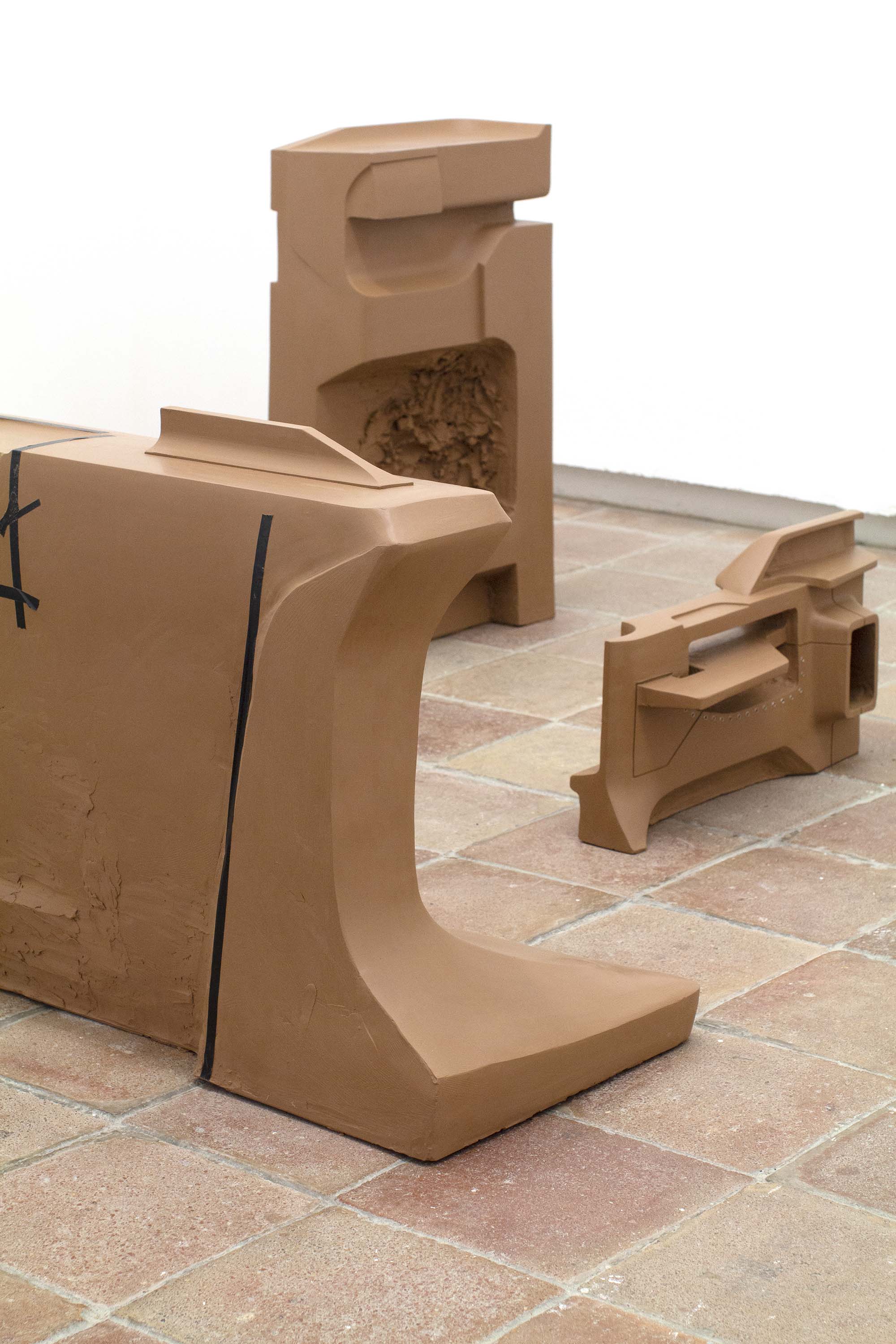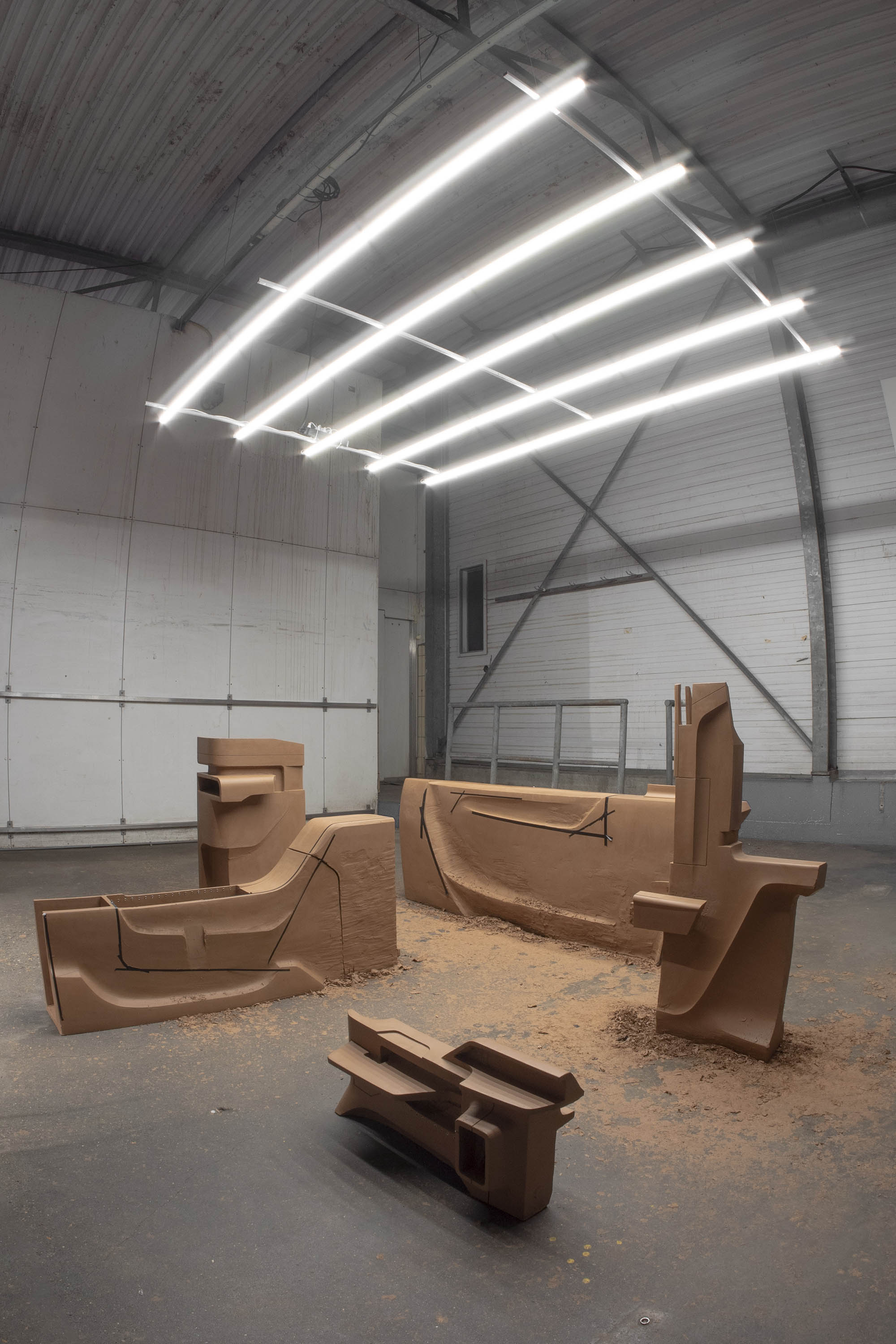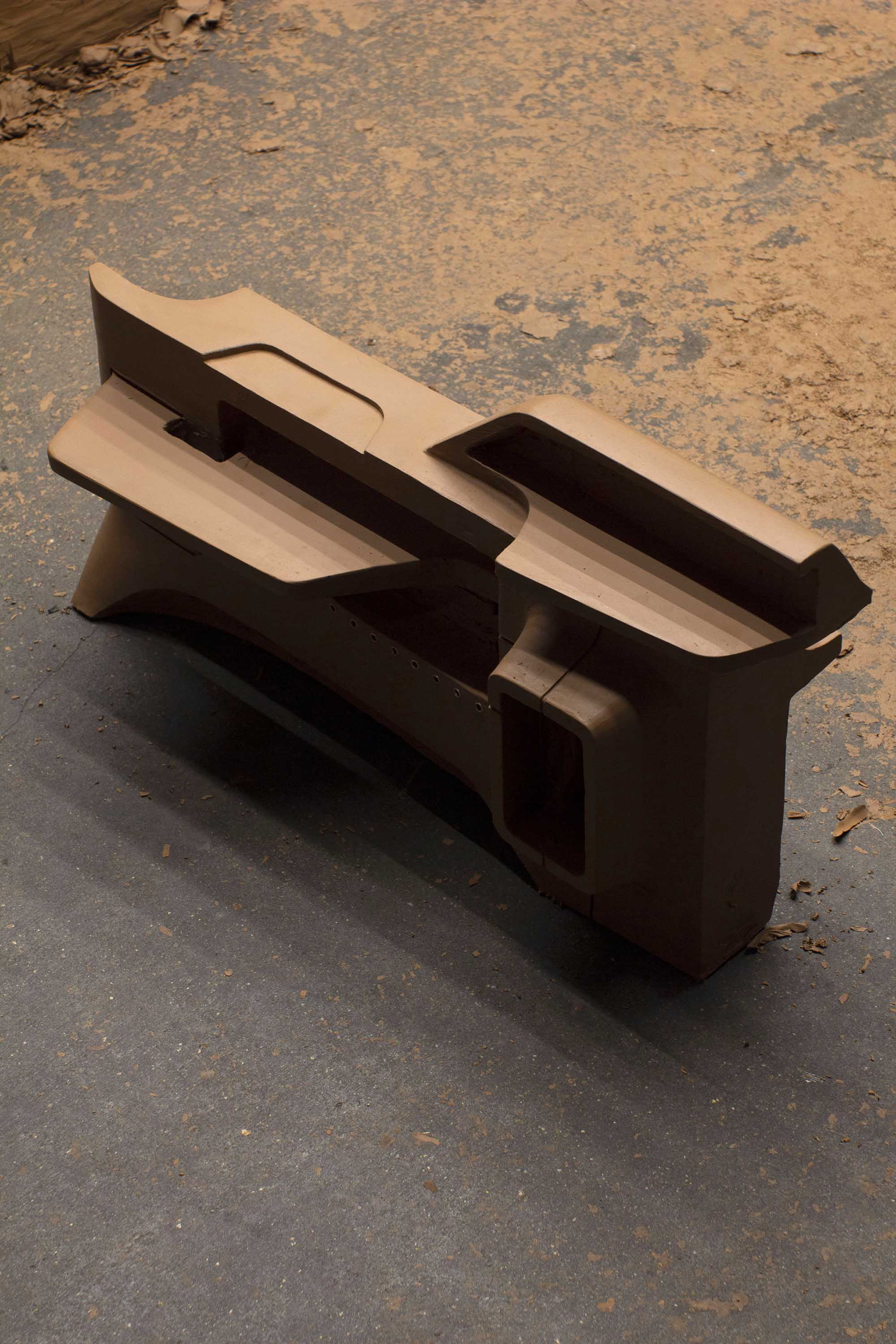
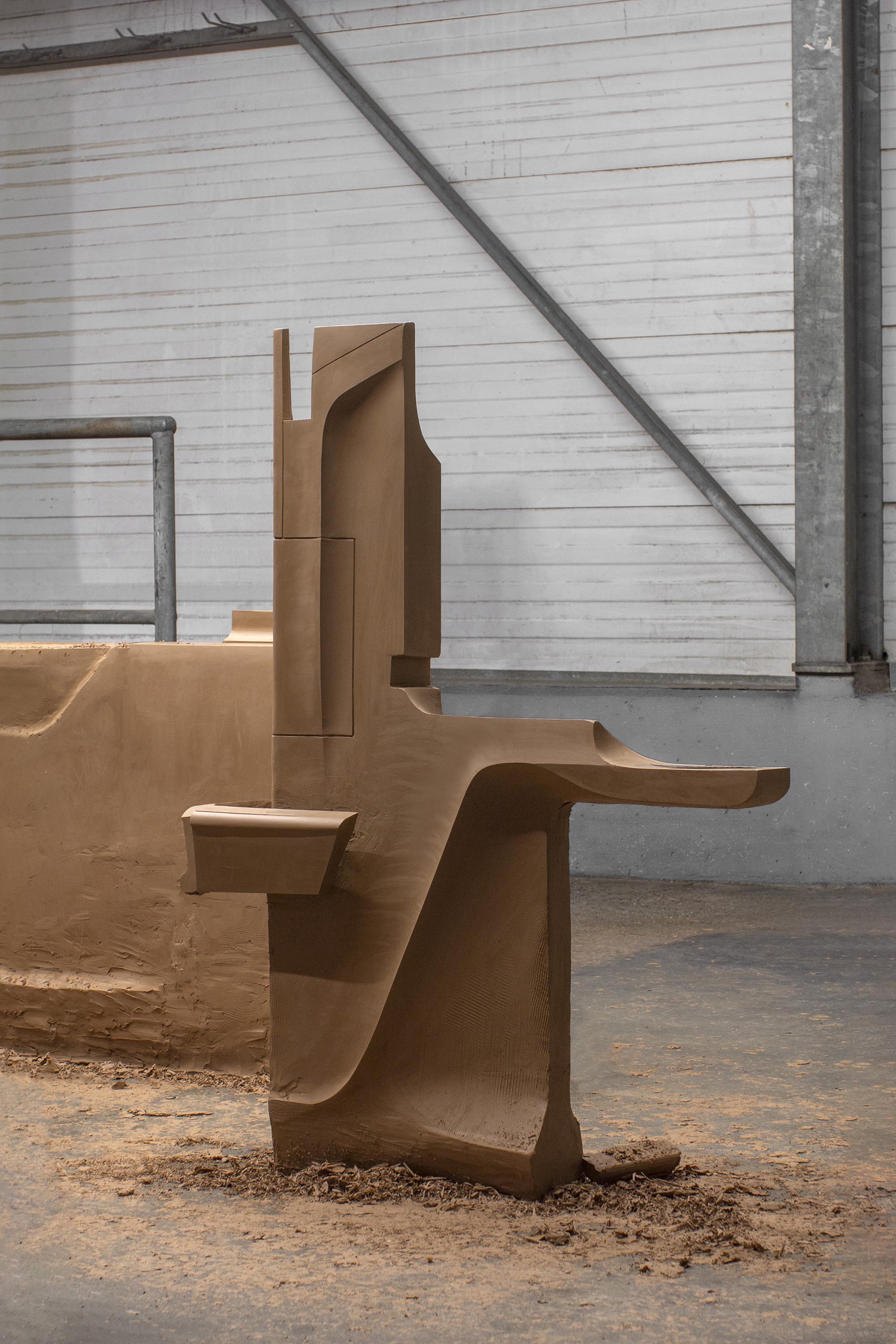

Terra Incognita is a collection of products that embraces the constant transformation of styles and aesthetic languages by working with industrial clay, also referred to as plasticine, a material normally used to sculpt the surfaces of car prototypes. By rethinking this clay not as a temporary modelling medium but as the product material itself, the collection explores how adaptation and change can become inherent qualities of an object.
The collection features five 1:1 hand-sculpted models. The objects inhabit an abstract language between furniture design and concept car, belonging to neither one nor the other. The formal language was evolved and refined in collaboration with car designer Daniel Rauch.
While each is captured in the midst of its creation, they embody transformation as an inherent quality, allowing the product to evolve by reshaping its body rather than being replaced.
The project speculates on the concepts of aesthetic innovation as opposed to technological innovation. While the rarely seen industrial craft of automotive clay modelling aims to encourage the purchase of a new product by altering its appearance through styling, the purpose of this collection is to reverse the use of the clay. The properties of the prototyping material are elevated so that it becomes the product material itself.
The history of product styling is closely tied to the automotive industry, where frequent model changes were introduced as a strategy to stimulate consumer demand, particularly following the economic pressures of the 1930s. Since then, aesthetics have continued to influence market dynamics, with new styles often taking precedence over technological innovation. Industrial clay has been used in automotive design for over a hundred years to create prototypes of new car models. When heated, the clay becomes soft and malleable, allowing shapes to be easily formed and added to. Once cooled, the clay hardens, allowing it to be scraped, reshaped or refined using rasps and blades. This combination of stability and malleability means that the clay can retain its form while remaining adaptable and reusable over time.
While contemporary design today emphasises sustainability, timelessness, and circularity, mass-production industries such as automotive, fashion, and electronics still rely heavily on aesthetic-driven obsolescence. The emotional and stylistic dimensions of design strongly influence consumption yet remain largely absent from theoretical discourse, highlighting the need to reconsider how systems and resources can adapt to the continual evolution of taste.
The collection features five 1:1 hand-sculpted models. The objects inhabit an abstract language between furniture design and concept car, belonging to neither one nor the other. The formal language was evolved and refined in collaboration with car designer Daniel Rauch.
While each is captured in the midst of its creation, they embody transformation as an inherent quality, allowing the product to evolve by reshaping its body rather than being replaced.
The project speculates on the concepts of aesthetic innovation as opposed to technological innovation. While the rarely seen industrial craft of automotive clay modelling aims to encourage the purchase of a new product by altering its appearance through styling, the purpose of this collection is to reverse the use of the clay. The properties of the prototyping material are elevated so that it becomes the product material itself.
The history of product styling is closely tied to the automotive industry, where frequent model changes were introduced as a strategy to stimulate consumer demand, particularly following the economic pressures of the 1930s. Since then, aesthetics have continued to influence market dynamics, with new styles often taking precedence over technological innovation. Industrial clay has been used in automotive design for over a hundred years to create prototypes of new car models. When heated, the clay becomes soft and malleable, allowing shapes to be easily formed and added to. Once cooled, the clay hardens, allowing it to be scraped, reshaped or refined using rasps and blades. This combination of stability and malleability means that the clay can retain its form while remaining adaptable and reusable over time.
While contemporary design today emphasises sustainability, timelessness, and circularity, mass-production industries such as automotive, fashion, and electronics still rely heavily on aesthetic-driven obsolescence. The emotional and stylistic dimensions of design strongly influence consumption yet remain largely absent from theoretical discourse, highlighting the need to reconsider how systems and resources can adapt to the continual evolution of taste.
Design, Concept, Production Johanna Seelemann
DevelopmentJohanna Seelemann, Daniel Rauch
Special ThanksStaedtler, Daniele Misso, Birta Rós Brynjólfsdóttir, Sabrina Kraus, Benjamin Werner, Simon Badstübner, Ianis Dobrev, Saga Rantanen, Bruno Szenk, Daf Trucks, Louise Schouwenberg
Picture CreditsJohanna Seelemann
Prize Design Parade Hyères x Eyes on Talents x Frame, 2021, Winner
Exhibitions︎︎︎ ‘Intergenerational Graduation Show’, Design Academy Eindhoven, Salone del Mobile, Milan, 2022
Johanna Seelemann
DevelopmentJohanna Seelemann, Daniel Rauch
Special ThanksStaedtler, Daniele Misso, Birta Rós Brynjólfsdóttir, Sabrina Kraus, Benjamin Werner, Simon Badstübner, Ianis Dobrev, Saga Rantanen, Bruno Szenk, Daf Trucks, Louise Schouwenberg
Picture CreditsJohanna Seelemann
Prize Design Parade Hyères x Eyes on Talents x Frame, 2021, Winner
Exhibitions︎︎︎ ‘Intergenerational Graduation Show’, Design Academy Eindhoven, Salone del Mobile, Milan, 2022
︎︎︎ ‘Design Parade 15’, Villa Noailles, Hyères, 2021
︎︎︎ ‘DAE Gradshow’, Dutch Design Week, Eindhoven, 2019
Context
Master of Contextual Design, 2019
Design Academy Eindhoven