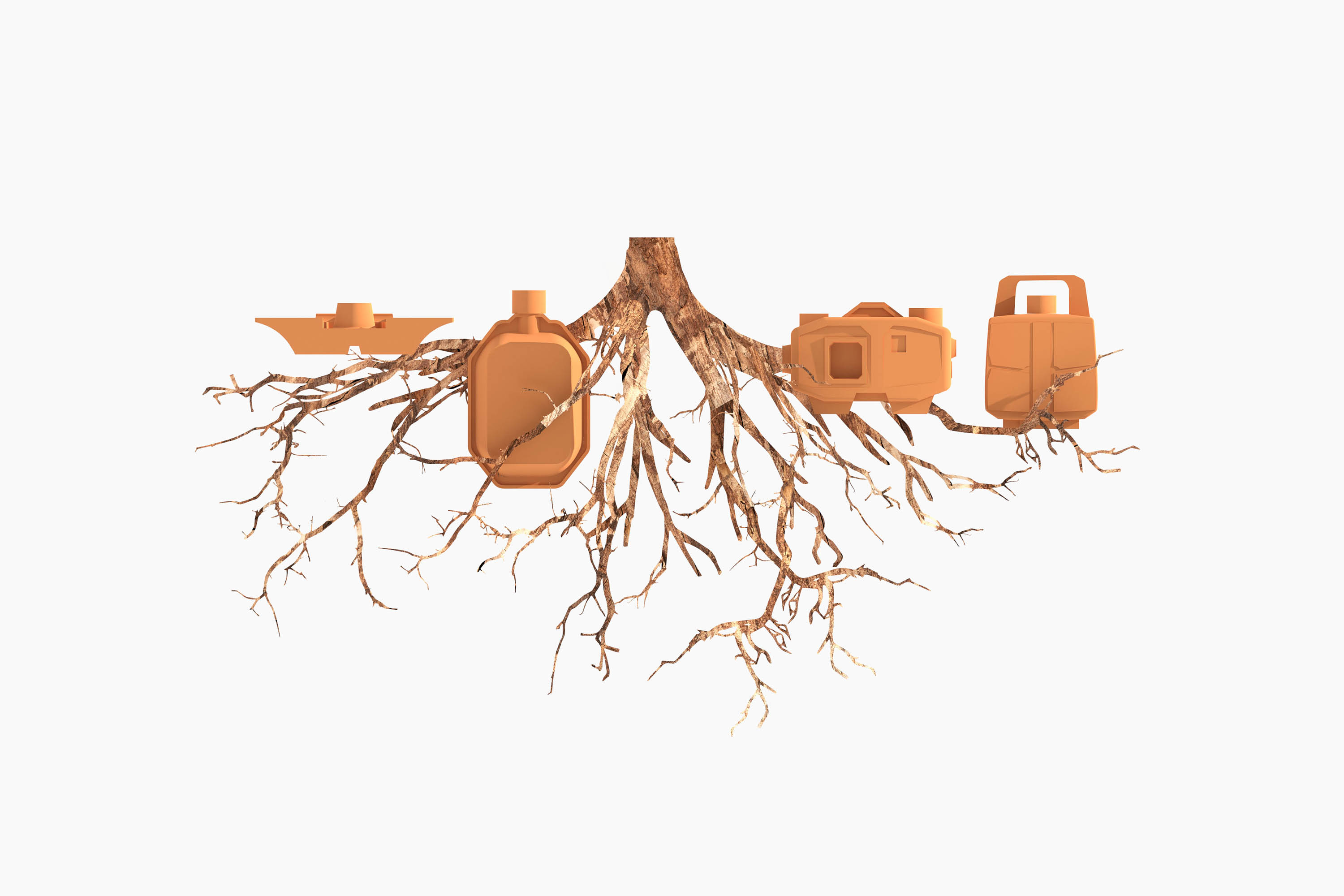
Oase proposes an intervention to alleviate the conditions of trees in urban spaces, drawing on an ancient low-tech irrigation method. Unglazed terracotta pots act as water reservoirs. When buried near a tree, the porous material enables the tree's roots to absorb moisture. The project was commissioned by the MAKK Museum in Cologne.
Oase highlights the essential role of greenery in the city. Urban trees are exposed to environments shaped for humans. Despite being a vital part of ecological and urban health, trees are often marginalised and regarded as inert 'street furniture' rather than living beings. This results in various challenges for tree health, such as sealed surfaces, a lack of clean water, overheating, wind channelling, compacted soil and restricted root zones.
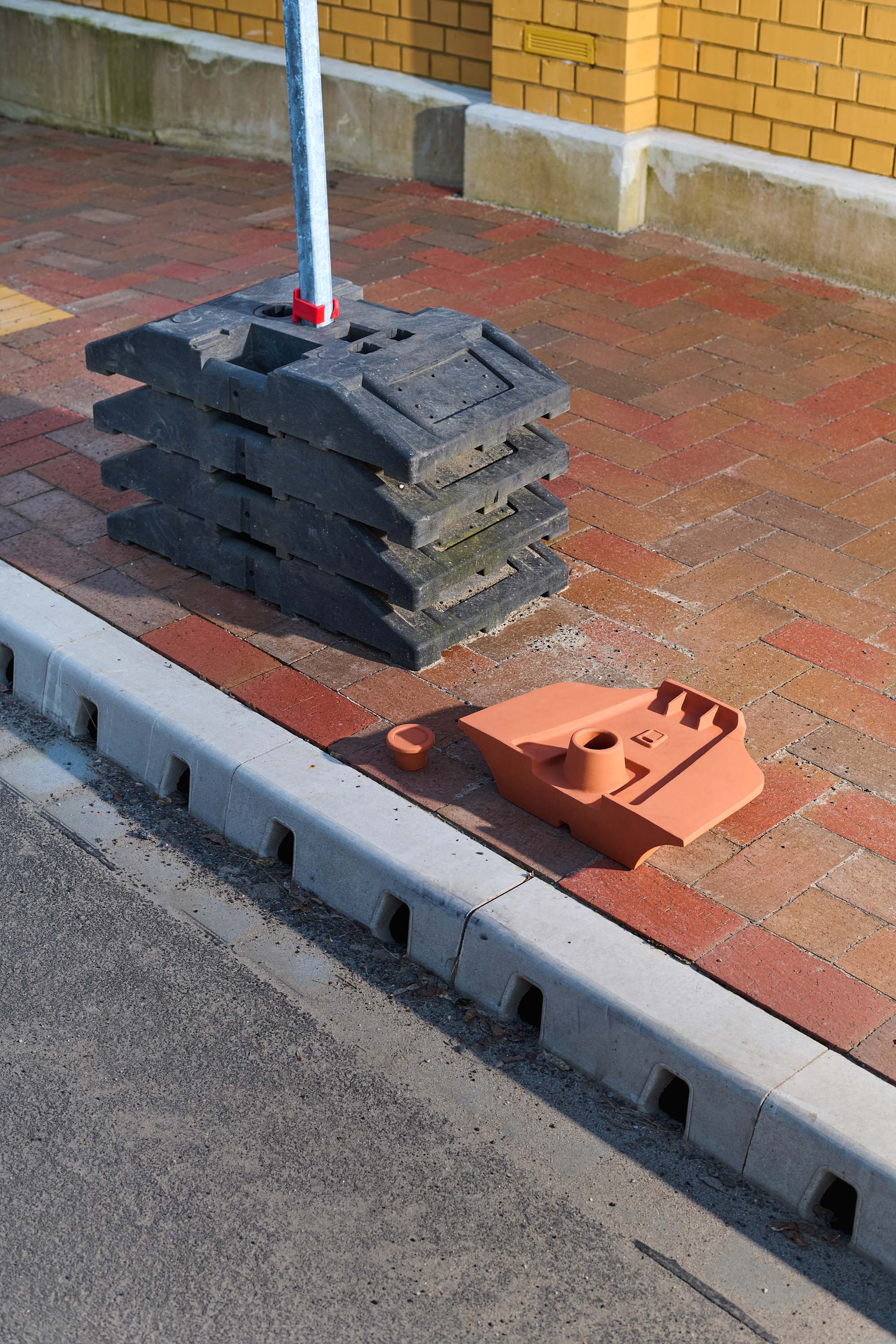
A sufficient supply of water increases the resilience of trees. Drawn from the concept of an oasis, a fertile patch of land in desert environments that provides habitats for plants and animals, the clay vessels improve water efficiency by eliminating losses from surface evaporation and seepage. Several material tests were conducted to determine the optimal clay composition and firing temperature, ensuring the vessels achieve the right balance between water storage capacity and permeability. Designed as a tribute to urban trees, their aesthetic language references the fuel tanks of cars, highlighting the tension between natural and urban infrastructures.
Oase is part of a broader shift in design, where we are beginning to understand ourselves not as separate from nature, but as part of it, recognising the interdependencies that sustain ecosystems. Design has always been an agent of change, interpreting transformations and attempting to ensure they affect us positively; more-than-human design goes further, seeking to support multispecies collaboration, care, and reciprocity rather than focusing solely on human needs. Oase demonstrates how gestures — such as providing urban trees with clean water — can contribute to a larger approach, pointing toward cities where human and non-human life coexist, even if that means returning and sharing space.
Oase highlights the essential role of greenery in the city. Urban trees are exposed to environments shaped for humans. Despite being a vital part of ecological and urban health, trees are often marginalised and regarded as inert 'street furniture' rather than living beings. This results in various challenges for tree health, such as sealed surfaces, a lack of clean water, overheating, wind channelling, compacted soil and restricted root zones.
A sufficient supply of water increases the resilience of trees. Drawn from the concept of an oasis, a fertile patch of land in desert environments that provides habitats for plants and animals, the clay vessels improve water efficiency by eliminating losses from surface evaporation and seepage. Several material tests were conducted to determine the optimal clay composition and firing temperature, ensuring the vessels achieve the right balance between water storage capacity and permeability. Designed as a tribute to urban trees, their aesthetic language references the fuel tanks of cars, highlighting the tension between natural and urban infrastructures.
Oase is part of a broader shift in design, where we are beginning to understand ourselves not as separate from nature, but as part of it, recognising the interdependencies that sustain ecosystems. Design has always been an agent of change, interpreting transformations and attempting to ensure they affect us positively; more-than-human design goes further, seeking to support multispecies collaboration, care, and reciprocity rather than focusing solely on human needs. Oase demonstrates how gestures — such as providing urban trees with clean water — can contribute to a larger approach, pointing toward cities where human and non-human life coexist, even if that means returning and sharing space.
Client MAKK Museum for Applied Art Cologne
Design, Concept, ProductionJohanna Seelemann, 2023
Assistance Gigi Totaro
Speacial Thanks Susann Paduch
Exhibition
Available upon request︎︎︎
MAKK Museum for Applied Art Cologne
Design, Concept, ProductionJohanna Seelemann, 2023
Assistance Gigi Totaro
Marc Goldbach
Eric Maget
Speacial Thanks Susann Paduch
Ökorausch Think Tank e.V.
Exhibition︎︎︎ ‘Between the Trees’, MAKK Museum für Angewandte Kunst Köln, 3 February - 16 April 2023
︎︎︎ ‘Micrographia’, Salone del Mobile Milan, 16 - 21 April 2024
︎︎︎ ‘Salone di Aschau’, Nils Holger Moormann, 13 - 14 July 2024
Available upon request︎︎︎